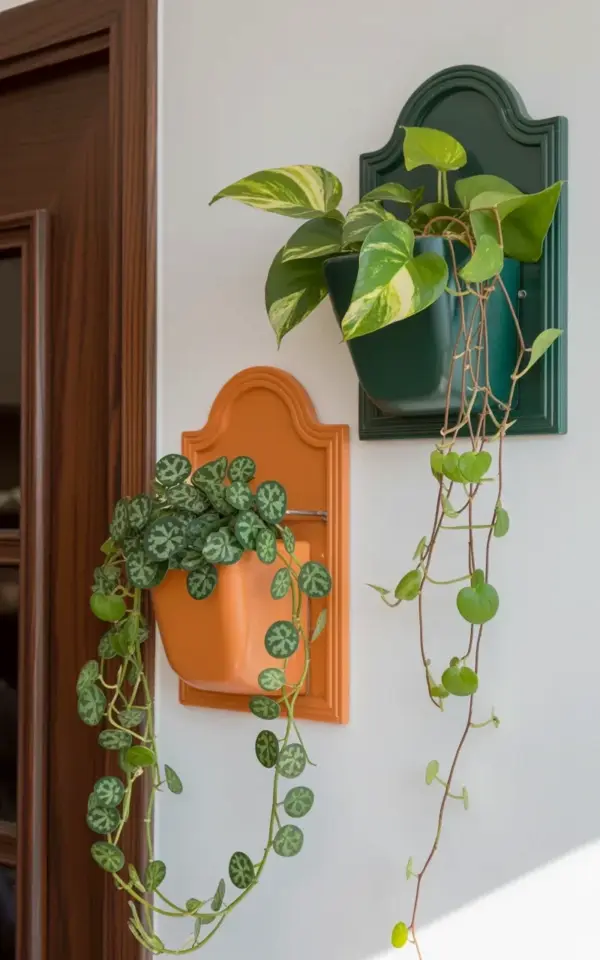
There’s a white wall next to a dark wooden door frame in my friend’s apartment, and it’s the first thing you see when you walk in. Hanging on it are two terracotta wall planters with scalloped edges, one dark green, one orange. The green one holds a pothos with glossy cream and speckled leaves. The orange one spills string of hearts vines down like tiny green beads on a necklace. Honestly, I couldn’t stop staring at them. If you’re hunting for terracotta wall planters, take this as your sign to go for the scalloped kind.
Why Scalloped Edges Make Terracotta Wall Planters Stand Out
Most wall planters are just half-pots with a hole in the back. Scalloped ones feel different. They remind me of vintage picture frames or those fancy ceramic plates people used to display on shelves. The wavy rim adds a soft, almost whimsical touch that a plain circle just can’t match.
In the photo, the dark green planter and the orange planter both have that same shell-like edge. It makes them look deliberate, like someone actually decorated the wall instead of just sticking a pot up there. Scalloped planters also catch shadows in a nice way. When the light hits the ridges, it creates a little rhythm across the surface.
And here’s something I didn’t expect. The scalloped frame actually helps hide the plastic nursery pot inside. You can tuck a clear or white inner pot right in, and the wavy edge covers up any unsightly rim. So you get a clean look without repotting anything.
The Perfect Plant Pair: Pothos and String of Hearts
These two trailing plants are like peanut butter and jelly. They don’t look alike at all, but they somehow make each other look better. The pothos has broad, glossy leaves with that lovely cream variegation. The string of hearts has tiny, round, purple-green leaves that grow on thin, wiry stems.
In the photo, the pothos sits in the dark green planter and its leaves sort of spread out and mound over the rim. The string of hearts in the orange planter just cascades straight down, like a waterfall of little coins. The contrast in texture is what makes it work.
If you’re new to trailing plants, this is a really forgiving combo. Pothos is famously hard to kill. String of hearts is a little more particular about watering, but it’s still a great beginner plant once you get the hang of it. I killed my first string of hearts by overwatering, so trust me, we’ll cover that later.
Here’s a quick rundown on each one:
- Pothos: bright, indirect light, water when the top inch of soil is dry, grows fast and forgiving.
- String of hearts: needs a bit more light, water only when the soil is completely dry, those little beads store water, so neglect is fine.
- Both root easily from cuttings, so you can share them with friends.
Dark Green or Orange? Matching Planter Colors to Your Home
The photo shows two very different color moods. The dark green planter feels calm and grounded. It lets the pothos shine without competing for attention. Green on green, but with different shades, it just works. I mean, the leaves are lighter, creamier, and the planter is deep forest green. You get this layered look that feels very sophisticated.
The orange planter, on the other hand, is a little shouty. In a good way. Orange is warm and energizing, and it makes the delicate string of hearts pop. The tiny green leaves stand out against that burnt clay tone. It looks almost Mediterranean, like something you’d see on a terrace in Spain.
So which should you pick? That depends on your wall. If your walls are white or gray, orange adds a welcome punch of color. If your room already has warm wood tones, dark green will blend in nicely. But honestly, you don’t have to choose. Hang both side by side like in the photo and you get the best of both worlds. The contrast between the two planters is part of the charm.
Where to Hang Terracotta Wall Planters for the Best Light
Notice the spot in the photo. It’s next to a dark wooden door frame, right in a walkway. Not right in front of a window. That wall still gets indirect light because the door frame opens into the room, but it’s not harsh. Both pothos and string of hearts prefer bright, indirect light anyway. A little morning sun is okay, but direct afternoon sun can scorch the leaves or fade the planter’s color.
If you hang your terracotta wall planters in a shady corner, they’ll probably survive, but they won’t thrive. Pothos will get leggy, with long spaces between leaves. String of hearts will lose its chubby little leaves and look sad. So find a spot that’s close to a window, but not in the direct beam.
Also, think about how people walk past it. The photo shows the planters mounted at eye level, next to a door frame. That’s smart because you get to enjoy them without bumping your head. If you have a narrow hallway, don’t hang them right where people will brush against them. I learned that the hard way when my string of hearts snagged on my sleeve and pulled some vines right out of the pot.
One more tip. Make sure the wall can handle the weight. Terracotta is heavy. Fill a planter with wet soil and a plant and you’re looking at maybe five to eight pounds. Use a proper drywall anchor or find a stud. I once tried to hang a planter on a flimsy plastic anchor and it came crashing down at 2 AM. The pot broke, the plant survived, but I didn’t sleep well for a week.
Caring for Pothos and String of Hearts in a Wall Planter
Wall planters are a bit different from regular pots because you can’t just peek at the soil from the top. You have to reach up and feel it. And water can drain out of the front, which is a mess. So here’s what works for me.
Use a cachepot system. Put a plastic liner inside the terracotta planter, with a drainage hole, and take it down to water. Or, if your terracotta planter has a drainage hole, place a saucer inside the back or be prepared to water sparingly. In the photo, both planters look like they’re mounted directly, but they almost certainly have some kind of inner pot or dripping mechanism.
For pothos, I water when the soil feels dry to the touch, usually every 7 to 10 days. For string of hearts, I wait until the leaves start to look slightly wrinkled or the soil is bone dry. You can’t overwater these plants. That’s the quickest way to kill them. When the stems sit in soggy soil, they rot at the base and the whole vine just falls apart.
Another thing. Rotate your planters occasionally. The side facing the wall gets less light, so the plant will grow unevenly. Turn the planter a quarter turn every few weeks to keep the growth around the whole rim. That keeps the cascade looking full and balanced.
Other Plants That Work in Scalloped Terracotta Holders
You’re not limited to pothos and string of hearts. The scalloped design actually makes the planter itself a decorative piece, so the plant just adds to it. Some other trailing plants that look great in these holders are heartleaf philodendron, which looks a lot like pothos but with solid green leaves, and hoya, like the variegated hoya australis. Those are both slower growers, but they’re gorgeous.
You could also try small trailing plants like senecio rowleyanus, or string of pearls. They need a bit more care, but the little beads look amazing up against a scalloped rim. If you want something bushier, a compact fern or a small begonia could work too. The trick is to pick a plant that spills a little, but not too much. You don’t want the whole planter covered. You want to see those scalloped edges.
Finding Your Own Scalloped Terracotta Planters
Scalloped planters aren’t everywhere, but they’re not impossible to find. Craft stores sometimes carry them in the pottery section. Big box garden centers usually have plain terracotta, but you’ll need to check online for the scalloped shapes. I’ve seen them on Etsy and even at small local pottery studios.
You can also paint plain terracotta yourself. Actually, that’s a fun weekend project. Buy a few plain terracotta wall planters, clean them, and use a sponge to dab on a scalloped pattern. Or just paint the whole thing with a glossy glaze. But I’ll be honest, the ones in the photo look professionally made. The glaze is even and the scalloped edges are crisp. It’s worth paying a little extra for that quality.
Look for planters that have a good mounting mechanism. Some come with a keyhole slot or a hook. Others just have a hole and you need to screw it into the wall. Check the weight rating and make sure the back is flush against the wall. If it wobbles, that’s no good.
Also, don’t forget about the size. The photo shows planters that are maybe six to eight inches across. That’s perfect for a pothos or string of hearts. Any bigger and the planter becomes heavy and harder to mount. Any smaller and the plant will outgrow it quickly.
So, there you have it. Scalloped terracotta wall planters aren’t just a pretty trend. They’re practical, charming, and they let you turn an empty wall into a living piece of art. Whether you go with pothos, string of hearts, or something else entirely, remember to enjoy the process. Pick plants you love, hang them somewhere you’ll see every day, and don’t forget to water them. Have you tried hanging plants on your walls yet? I’d love to know what you’d put in your own scalloped planter.
Leave a Comment