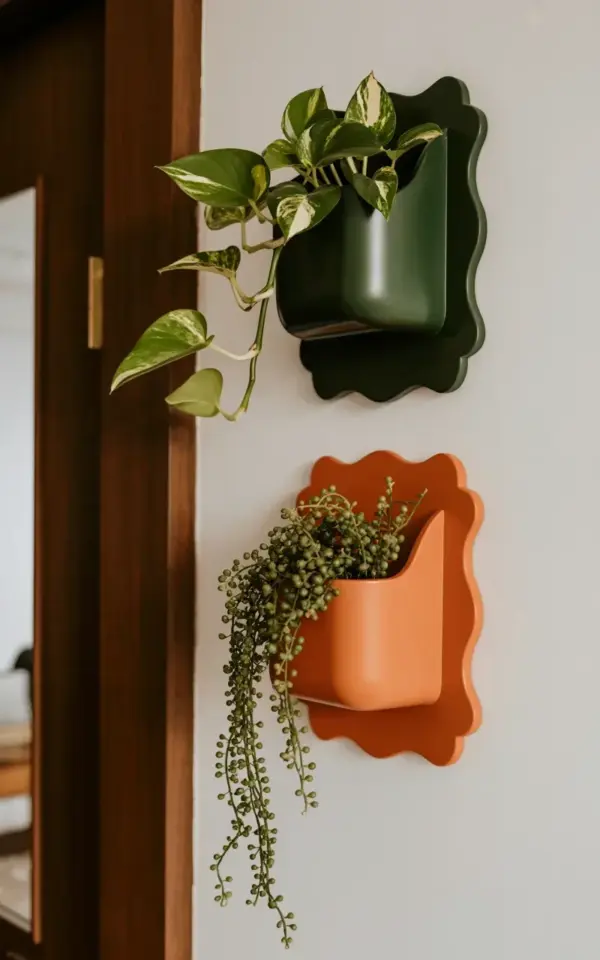
Two terracotta-colored planters hang on a white wall, their scalloped edges framing nothing but pure green chaos, in the best way. One spills variegated pothos, cream and glossy emerald tumbling over each other. The other releases a cascading curtain of string of hearts, tiny round leaves stacking down the wall like delicate beads. This trailing plant wall decor is trending for Autumn and honestly, it deserves a spot in your home.
I spotted this exact setup next to a dark wooden door frame, and the contrast stopped me mid-scroll. It’s not overly styled or fussy. It just looks alive. The kind of project that takes an hour on a Saturday, but pays off every single day you walk past it.
Why Terracotta Planters Work So Well for Wall Decor
There’s something about the warm, earthy tone of terracotta against a clean white wall that feels inherently grounding. It dials down the visual noise. The scalloped frames here add a softness that plain terracotta pots don’t have, a little bit of romance in the structure.
But beyond the beauty, wall-mounted planters save floor space. They make use of dead wall areas, especially beside doorways and in narrow hallways. And that pine green one next to the orange? It proves you don’t have to match everything perfectly. You can curate a small gallery of planters in complementary shades.
Look, I have a soft spot for imperfect matching. One dark green, one orange, both with that same charming scalloped edge. It feels collected over time, not bought as a set.
Best Trailing Plants for Beginners
Not every vine likes hanging on a wall, but two plants absolutely thrive there. Let’s talk about the stars of this photo.
- Pothos (Epipremnum aureum): Nearly indestructible. It tolerates low light and forgetful watering, making it the best first vine for a wall project.
- String of Hearts (Ceropegia woodii): A slow grower initially, but once established, the vines trail with a delicate, beaded look that’s unmatched.
- Hoya Carnosa: It handles the same conditions and rewards you with thick, waxy leaves that catch the light.
- Brazilian Edged Tradescantia: Fast grower, purple undersides, zero patience for being ignored.
How to Mount Planters Without Drilling (or With It)
The planters in the photo appear screwed into the wall, with the vines growing outward from terracotta holders. You can do that if you’re comfortable with a drill and a level, mark your holes, use wall plugs for the screws, and you’re set. But if you’re renting or you’d rather not make permanent holes, there’s a simpler route.
Command hooks, the ones with adhesive strips, hold surprisingly heavy loads these days. A small terracotta planter filled with pothos is totally manageable. For longer vines, spread the weight by threading the trailing growth through multiple hooks down the wall, a trick I saw on a rental-friendly ceiling installation and adapted for a vertical surface.
Make sure the hook sits flush against the pot’s rim or top edge. Otherwise, the planter tilts forward and refuses to hang straight. Not gonna lie, I’ve battled a crooked planter for a week before admitting the hook was wrong.
Styling Tips for a Scalloped Terracotta Wall
Positioning these planters near door frames is a move I fully support. The vertical line of the door echoes the vertical line of the trailing vines, creating a framework that makes the decor feel intentional. Try mounting them at eye level so the cascade has room to grow upward and outward, and let the vines hang past the frame ever so slightly.
Mixing a dark green planter with a warm orange one works because they share the same texture and finish. Different colors, same family. It keeps the arrangement cohesive without being boring. Add a small hand-painted detail on one of the pots if you want, a tiny line drawing of a leaf, some dots, nothing too kitschy. Scalloped edges are cute because they lean into the retro. Embrace that energy.
Avoid cramming too many planters close together. Double this setup at most, then let the plants fill in the gaps over time. The greenery becomes the filler, not more pots.
Caring for Pothos and String of Hearts on a Wall
Wall plants get less airflow than countertop plants, so check the soil moisture more frequently. Pothos likes its top inch of soil dry before a drink. String of hearts, on the other hand, has succulent-like leaves and prefers to dry out quite a bit between waterings. Overwatering the string of hearts is the fast lane to root rot.
Both plants appreciate bright, indirect light. The spot in the photo, beside a door frame, likely catches soft morning sun. That’s perfect. Too much direct afternoon sun scorches the leaves, but too little light makes pothos lose its variegation. Watch for the cream coloring fading to a flat green, that’s a sign to move the planter a foot closer to the window.
Feeding them is simple. Use a balanced liquid fertilizer at half strength, once a month in Spring and Summer, and skip the feeding entirely when growth slows in Winter. And dust the leaves now and then, not gonna lie, dusty trailing plants are a pet peeve of mine.
This Season’s Trend: The Return of Retro Planters
Scalloped edges and earth tones are having a moment. The minimal white pots from the mid-2010s are being swapped for pieces with character, texture, and color. This terracotta set leans into an organic modern vibe that fits the Autumnal mood of the year. It feels nostalgic, but with cleaner lines.
What sells the look is the contrast. The dark wooden door frame and the bright white wall are the backdrop. The planters bring the warmth, and the greenery brings the life. It’s a simple formula. Natural materials, living plants, alternating heights. Use a hanging pot for one and a shelf-sitter for the other, since breaking the level of your wall decor makes it look gathered and personal.
Instead of following the trend of painting everything sage, let the terracotta do the talking. It’s a timeless material, and the scalloped detail just makes it feel current again.
The 10-Minute Weekend Plant Project
Here’s the best part. This setup takes far less effort than you’d think. Between two pots, some hooks, and two nursery plants, you’re looking at a project that can be finished before your coffee gets cold. Screw in the planter hooks, use a tape measure or your best eye to keep them level, then pop in the nursery pots. Arrange the vines so they cascade down and slightly overlap the doorway trim. Done.
I’m a fan of buying a slightly larger pothos so it instantaneously spills over the rim. If you start with a small cutting, you’ll wait a few months for that dramatic effect. There’s nothing wrong with patience, but for a quick weekend win, go ahead and buy the established plant. The string of hearts, however, rewards a little patience, watch its tuberous roots develop and the vines thicken over time.
One note on safety. Make sure your screws or hooks are secured into a wall stud or use heavy-duty anchors. The last thing you want is a terracotta pot crashing down at 2 a.m. because a command strip gave out. Trust me, I lost a favorite pot that way once.
Where to Hang Them for Maximum Impact
Directly beside a door frame is a strong choice, as seen in the photo. Another great spot is flanking a window with the vines trailing on either side. Or use them to break up a long stretch of blank wall in a hallway. Walk into a room and let the eye land on the green first.
If you’re hanging them in a corner, stagger the heights of the planters to create motion. Put pothos on the left at eye level and string of hearts on the right a foot lower. The different vine lengths and leaf shapes will balance each other out.
The beauty of it is the flexibility. These planters can go in a bathroom, a bedroom, or a cozy reading nook by the kitchen.
So here’s my soft call-to-action, pick up a terracotta planter, grab a pothos or a string of hearts, and give your wall a little bit of green. It’s a small change that makes a big difference, and honestly, the trailing vines will thank you for the vertical space.
Leave a Comment